Two games.One battlefield.
Frontline is a competitive shooter with a commander on top of it. One player per team never fires a shot — they play from a top-down view, spending requisition on turrets, forward spawns and UAV stations. Everyone else fights on the ground in first person and lives or dies by what their commander built.
Steam wishlists open soon — get playtest invites →

Same match. Same second.
Two different screens.
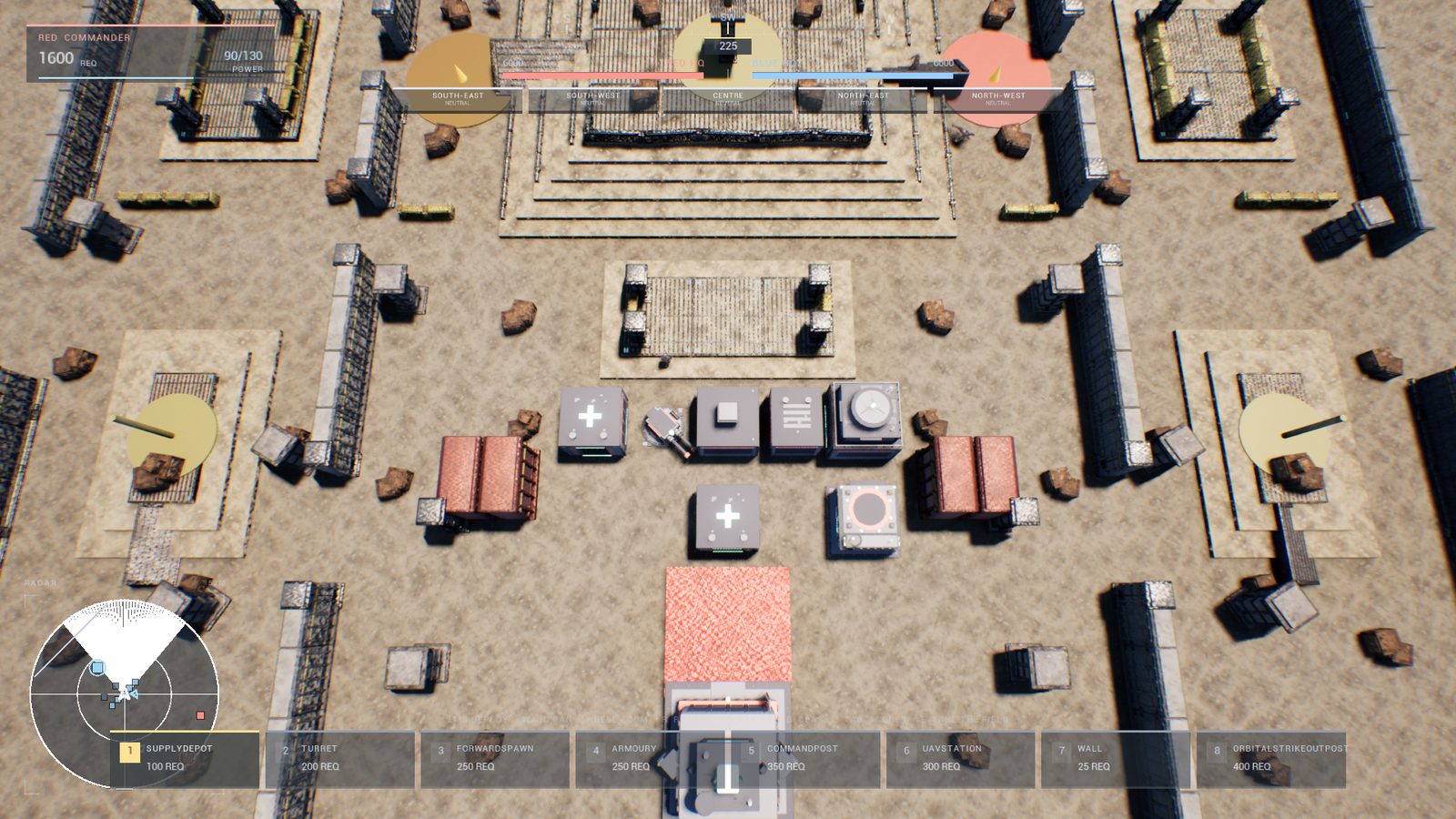
Requisition, a build palette, a power budget and the whole arena at once. He never fires a shot. Every structure on the field is a decision he made.
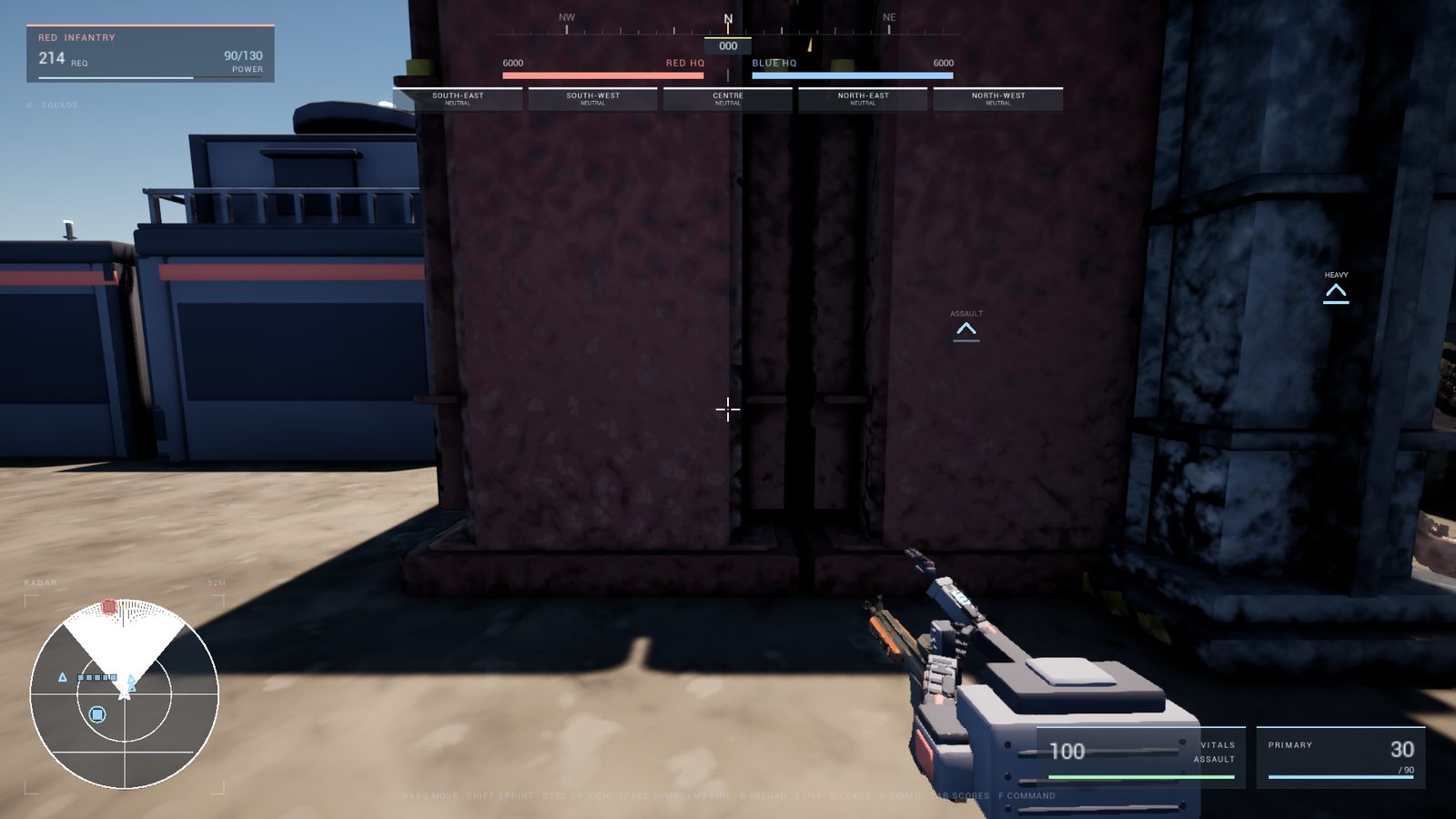
Ten metres of dust, one wall, and whatever the commander did or didn't build behind her. She finds out which in about four seconds.
Neither one of them can win alone.
That dependency is the entire game.
How the two halves pull on each other
It isn't a shooter with a build menu bolted on. The economy runs through the infantry fight, and the infantry fight runs on what the commander spent.
He places a turret. Thirty seconds later, she is holding the lane with it.
Turrets aren't autonomous decorations. A soldier walks up, presses E, and becomes the thing standing between the enemy and your HQ. One player spent 200 requisition on a hunch; another player is now cashing it.
Commander cost 200 REQ
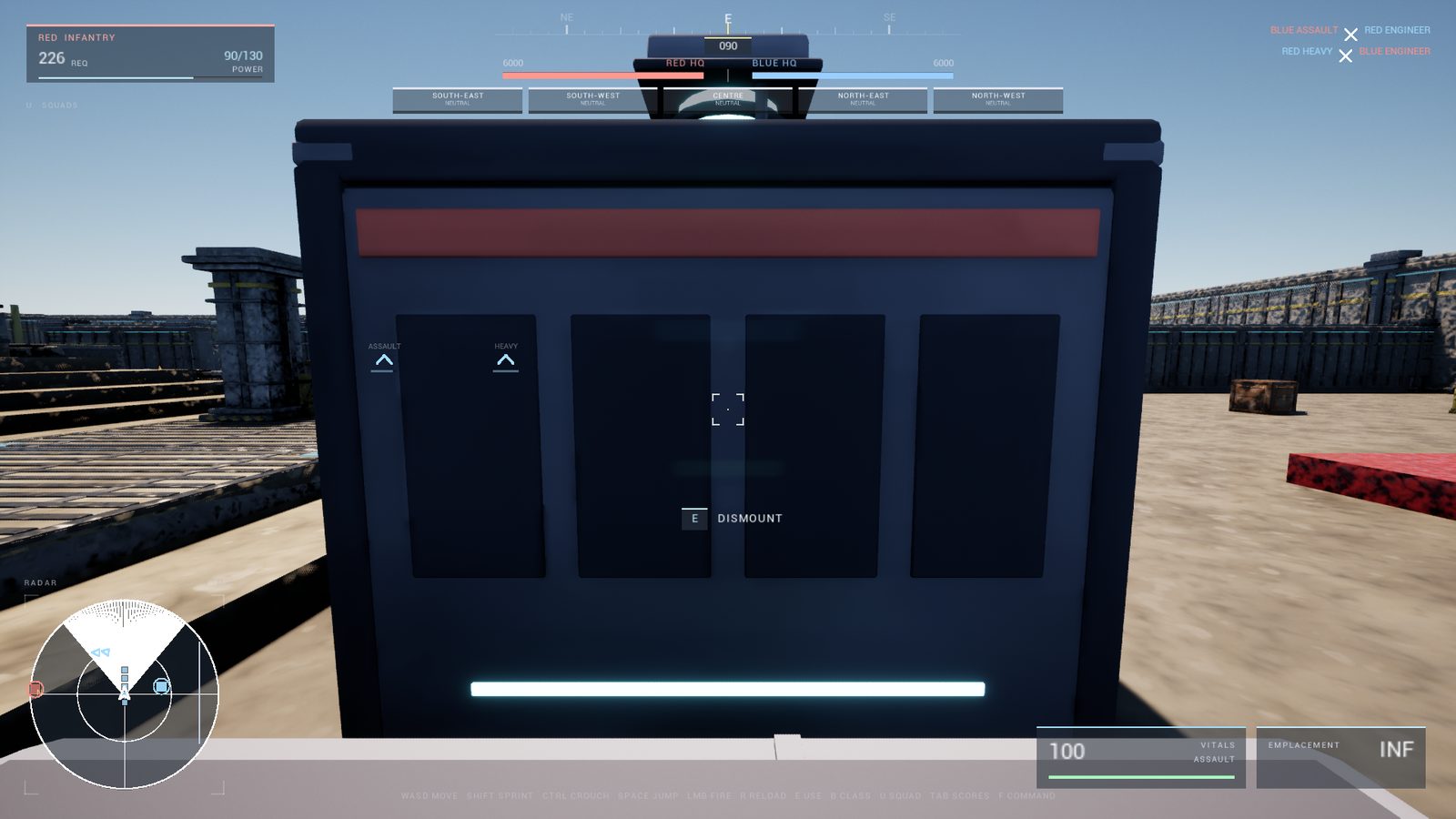
His greed is her dead turret
Build past your energy capacity and the entire team's structures shut off at once. Not a warning, not a debuff — every turret you own goes quiet simultaneously, until the commander fixes it.
Ground taken becomes buildings placed
Capture points feed the commander's requisition. So the infantry push isn't just territory — it's income. Ground taken becomes buildings placed becomes ground held.
You are relying on someone you cannot see
The soldier can't see the build menu. The commander can't see down the scope. Each one is making decisions on incomplete information, betting that the other one is doing their job.
Step into a UAV station and leave your body behind
Walk inside a UAV Station and you take control of a flying spotting drone, marking enemies for your team. Your body stays parked on the pad — awake, exposed, and someone else's problem. Cooldown-gated; three stations maximum.
Brownout
Every structure on the field draws power. Cross the line and they all stop working at the same instant — the turret she's standing on included.
Interactive illustration of the mechanic. Power capacity (220) is the value shown in the build's HUD; per-structure draw is not depicted.
The build palette
Costs are read straight out of the current build's rules. Rebalancing moves these numbers.

Wall
25The cheapest thing on the board, and the only one whose entire function is its collision. 320 HP — six rifle rounds, or a single Heavy siege shell.
Max 12, cap recycles
Turret
200Automated fire on a lane — until a soldier mounts it and takes over.
Player-mountable
Forward Spawn
250Moves the front line. The single most aggressive thing a commander can buy.

UAV Station
300Walk in, fly out. Take control of a spotting drone and mark targets from above.
Max 3 per team
Supply Depot
100Resupply point. The cheapest way to keep a push alive.

Armoury
250Upgrades for the people doing the shooting.

Command Post
350Forward command. The most expensive commitment on the board.
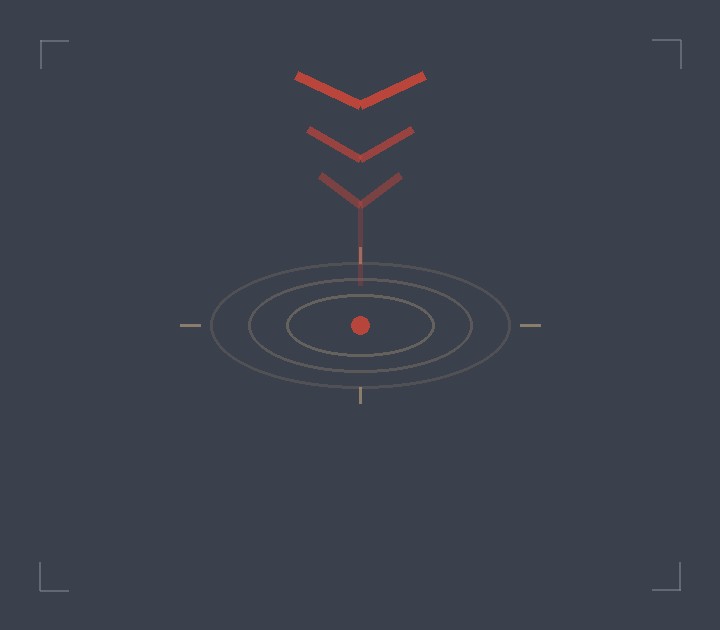
Strike Outpost
400The commander’s orbital battery. One per team, 90-second cooldown, and a four-second warning telegraph so anyone paying attention can walk out. It draws 35 energy — more than the base supply — so it cannot fire until the infantry have taken a power node.
Gated behind a captured node
Extractor
The exception: extractors are built by soldiers in the field, not by the commander.
Built by infantry
HQ
Where each team starts and what each team is trying to take down.

MK4 Rifle
The baseline weapon everything else in the sandbox reads against.
Two resources, six nodes
Requisition buys things. Energy decides how many of them can run at once. The map splits the two on purpose.
Both requisition nodes are on the centreline, contested and equidistant from both bases. Requisition snowballs, so it is deliberately the resource you have to walk into the open to hold.
Four energy nodes, one per quadrant. Energy only raises a ceiling, so a losing team keeps the lights on — they just cannot out-buy anyone.
A soldier claims a node by standing on it, and completing the claim builds the Extractor. The Engineer does it in half the time; the Heavy takes 6.4 seconds. Two enemies present freezes the bar.
Four classes
Every class carries three weapons: a primary, a sidearm, and a support slot — Burst Launcher, Repair Torch, Siege Cannon or Vector SMG. Twelve distinct weapon models across the four classes, not one shared rifle. Stats below are read from the current build.
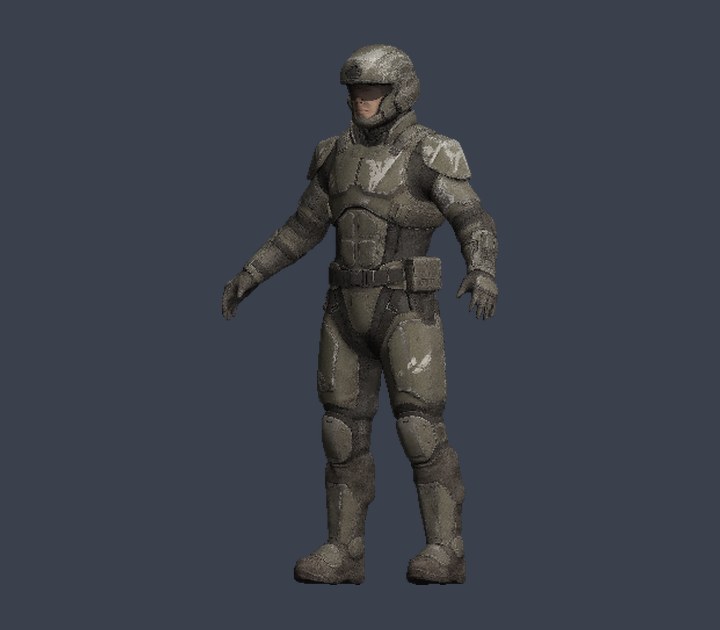
Assault
The baseline everything else reads against.
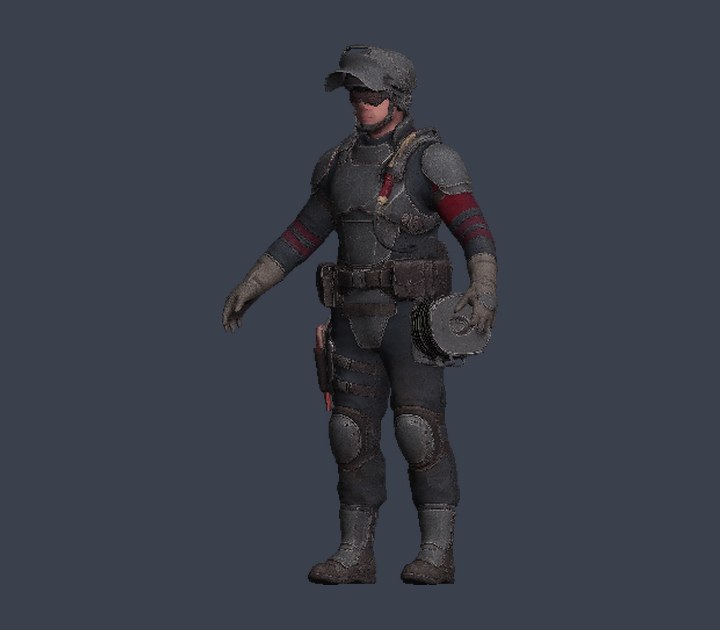
Engineer
Repairs structures and claims resource nodes twice as fast.
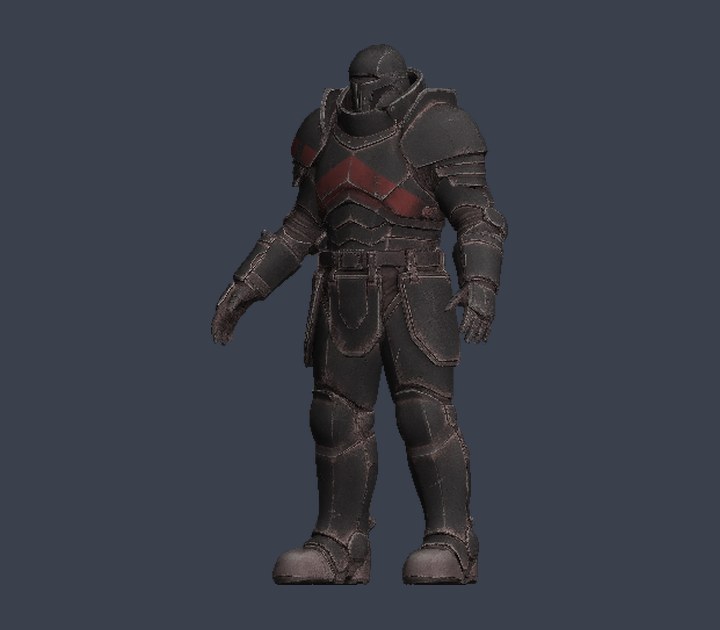
Heavy
Slowest on the field, best siege damage. Breaks stalemates.
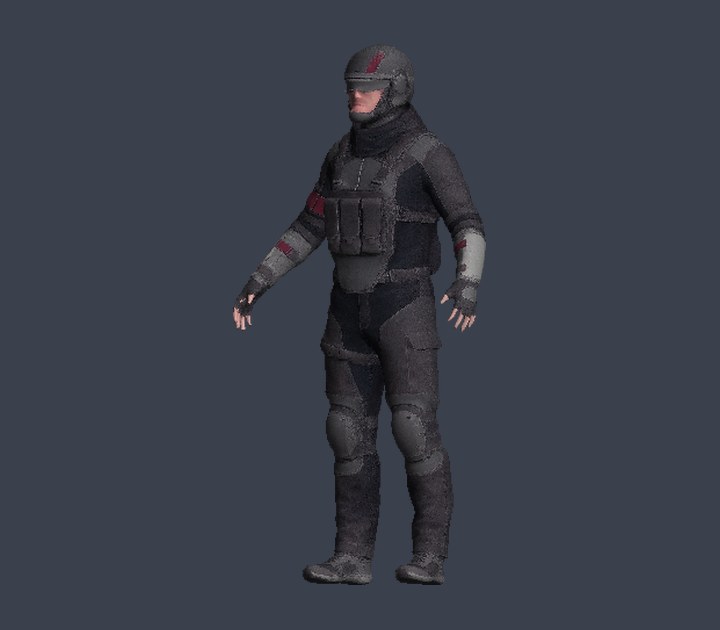
Scout
Fastest thing alive. Spreads the map, weakest in a straight fight.
Four rigged classes with PBR armour, each around 24,000 triangles — built, textured and animated in-engine, on a 24-bone skeleton with idle, walk, run and death. Not final art, but not placeholders either.
You spawn on your squad leader
That single rule is the system. Before squads, every soldier was a spawn beacon — which made the commander’s 250-REQ forward spawn strictly worse than whichever body happened to be furthest forward. Now the leader is a moving spawn point: worth protecting, and worth hunting.
A player creates a squad and becomes its leader, then invites teammates who accept or decline. Leaders can kick, promote, and rename the squad using NATO callsigns, ALPHA through HOTEL.
You spawn on your squad leader and nowhere else. Push too far alone and your squad has nowhere to arrive. Keep the leader alive and the whole squad keeps its footing.
A commander can order a squad to attack or defend a point, and the leader accepts or denies it. Orders expire if nobody answers. The commander directs the battle; they do not get to command the people in it.
Three tiers — and death only costs the trip back
Weapon upgrades are collected by walking into a friendly Armoury. Tiers improve handling before damage: spread and reload first, damage not until tier three.
The tier resets on death. The kills do not. Dying costs you the walk back to an Armoury, never the grind — which also means a brownout bites twice: an overspending commander strands every dead veteran at stock.
One walled desert arena
Oxide-red structures, one HQ, one commander, and the same 140 metres of sand to cross.
Cold navy structures, mirrored base, and a commander watching the same board from the other side.
Wall Corner
 Pillar
 Crate
Crate Barrier
 Ramp
Ramp Platform
 Pipe run
Crates, low barriers and cover break apart under sustained fire — 292 of the objects on the field are destructible, so the cover you planned your push around may not be there on the way back.
The build as it stands
Listen-server multiplayer is verified working over the internet — playable with friends now, not planned. Host controls are server-validated: kick, ban, and move players between teams. 28 sound cues are in: per-class weapon fire, footsteps on sand and metal, impacts by material, reload stages, hit and kill confirms, UI, and the brownout alarm.
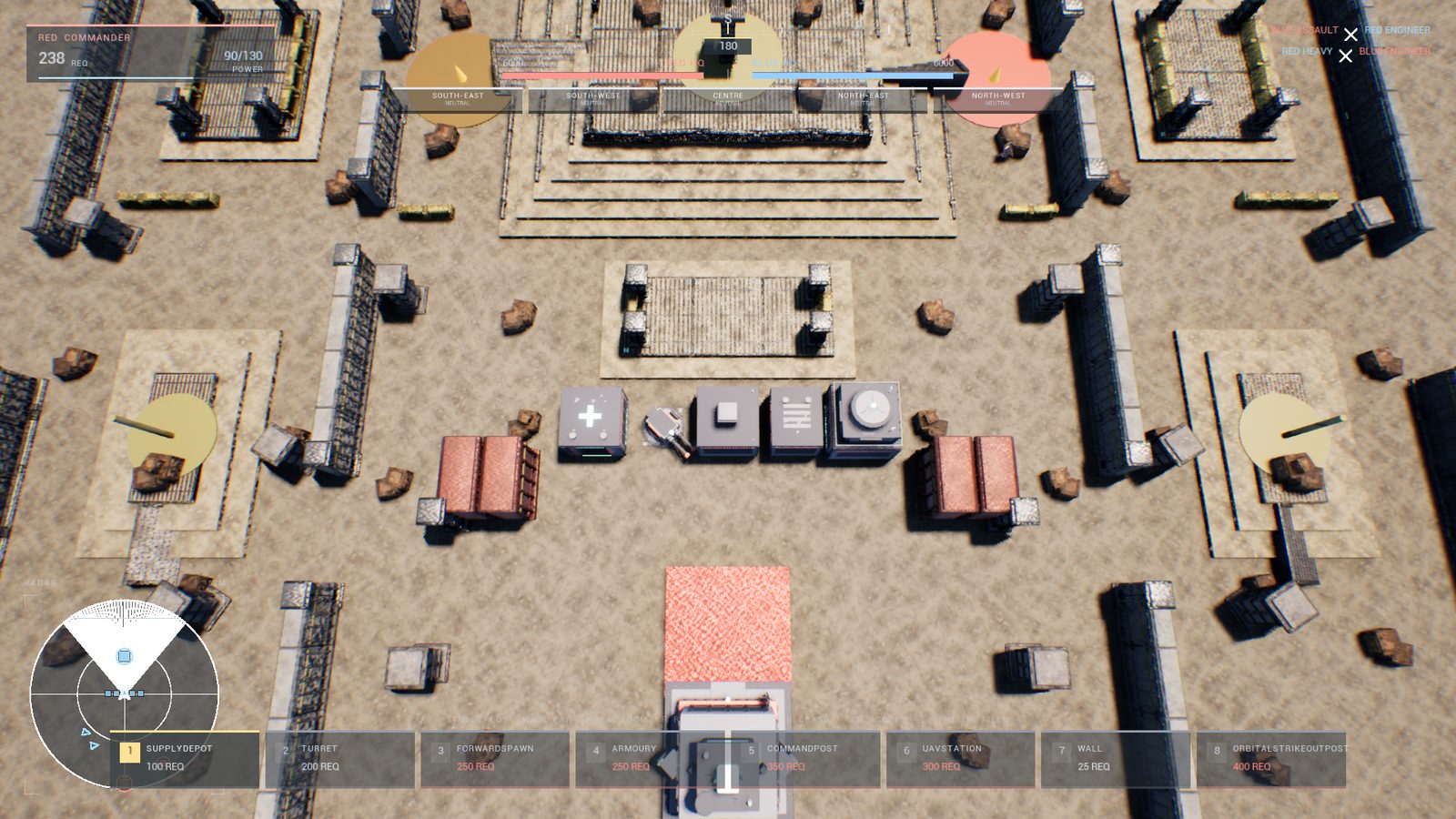 Commander · arena overview
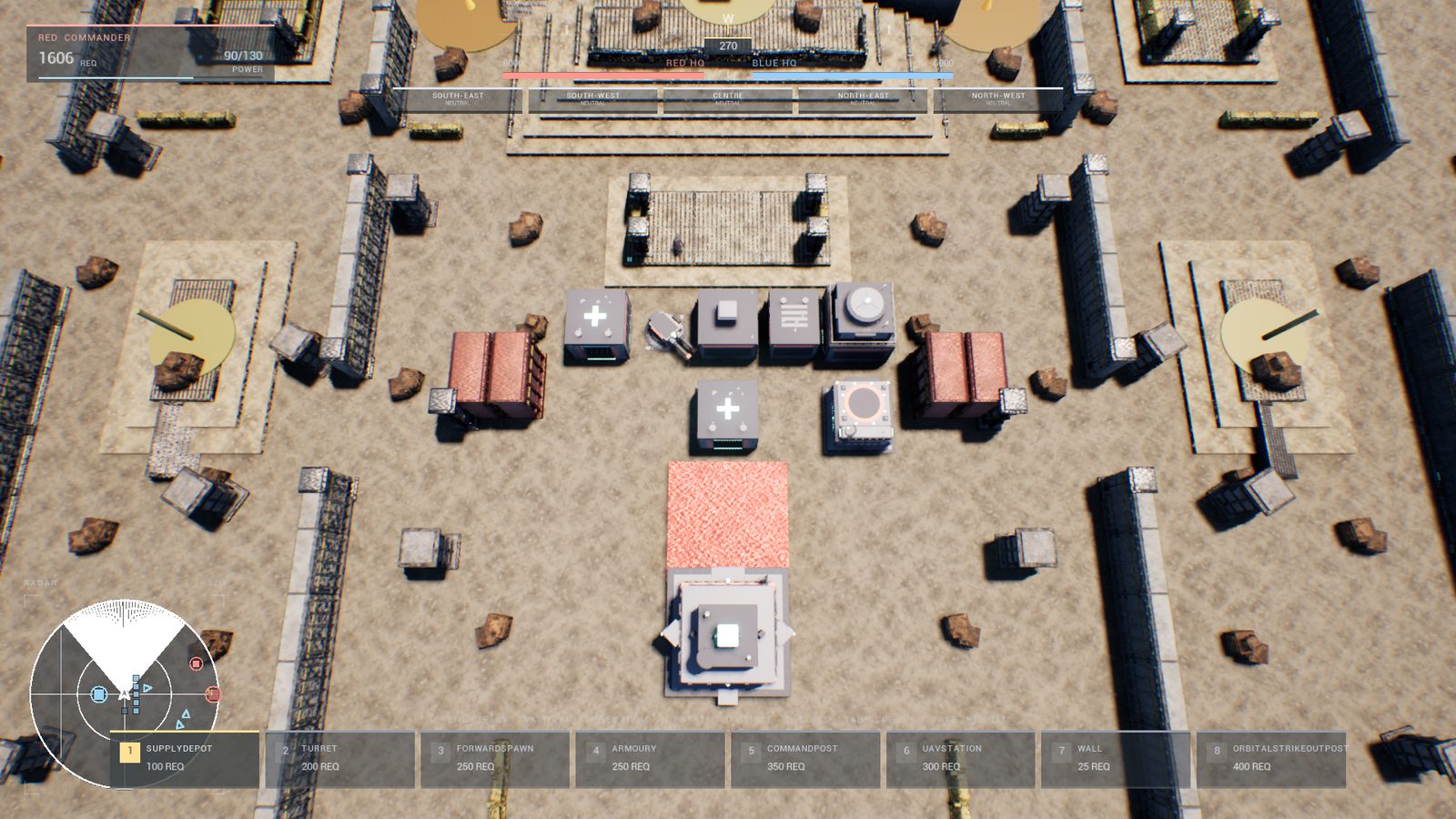 Commander · structures placed
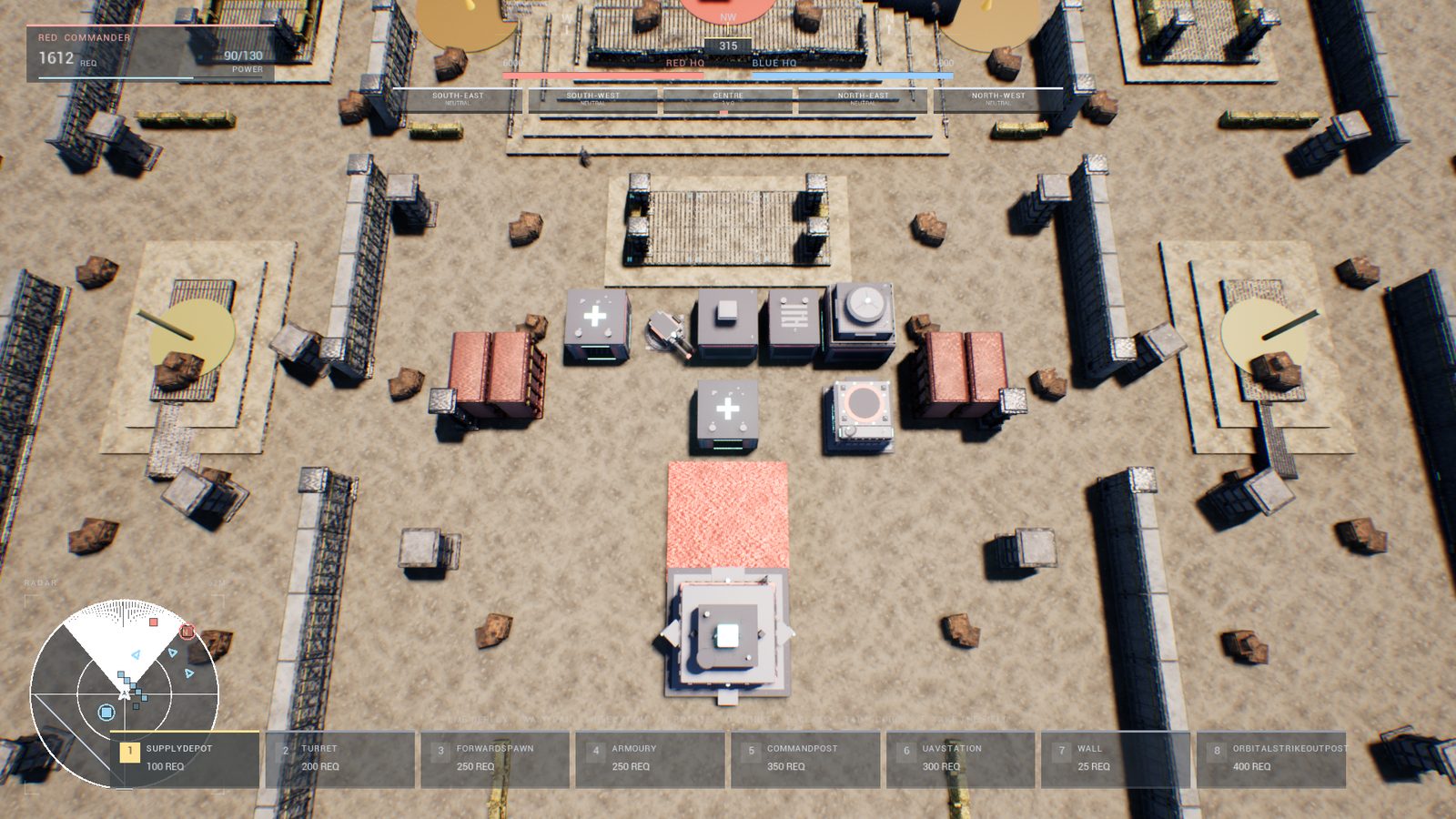 Commander · base layout
 Infantry · ground view
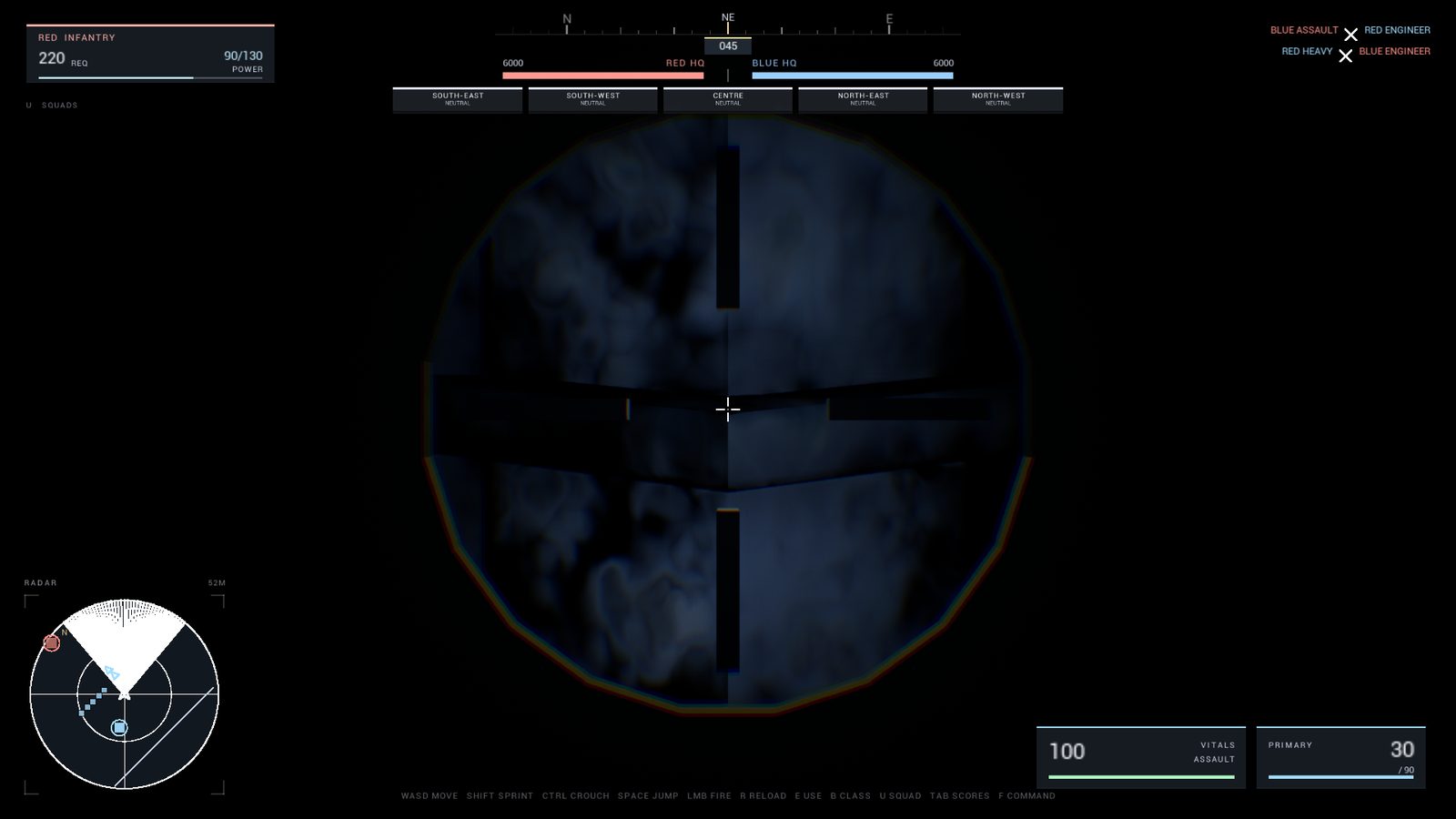 Infantry · aiming down sightsInfantry · turret mounted
All images captured from the current pre-alpha build. Environment, structures, weapons, HUD and lighting are representative.
Share the fight
Eight cards covering the pitch. Free to repost — click any card to open the full-size image.


Where it actually is
Frontline is a playable pre-alpha built by a small team. Here is what that means, stated plainly, so nothing on this page oversells the build — or undersells it.
Nothing drivable. The only thing that flies is the small spotting UAV.
Bots fill out both teams so matches run, but they path straight at their target and will grind against a commander's wall rather than go around it.
ADS is being re-derived for the new weapon models. It works, but the alignment is not final.
The new character meshes import self-lit, so they don't yet sit in the scene lighting the way they should.
Three weapon slots is the whole loadout. No grenades, no deployables for infantry.
Neither is in the build. Play with people you know.
The app exists and the store page is written, but it isn't public yet — wishlist link coming. No release window and no pre-order: no date, no price. When that changes, it'll change here first.
Listen-server multiplayer is verified over the internet, with server-validated host controls. This is playable with friends now.
The environment, structures, weapons, HUD and lighting you see on this page are the real build — not concept art, not a target render.
Watch it get built — then play it
Drop your email. We’re building Frontline in the open and inviting people in to playtest as we go — new systems, balance passes, and the first hands-on builds. Early testers get in first. No spam, unsubscribe anytime.